
Pax Abyssi
A whole galaxy at true scale, and a ship you can walk.
A first-person space simulation on Unreal Engine 5. Fly true Newtonian physics on a HOTAS through 119,626 real stars, land on procedural worlds and walk to the horizon, skim gas giants with weather of their own, and fly to black holes drawn by their physics. Set in the Freeholds in 2538.
- Catalogue stars
- 119,626CatalogueHYG database, corrected against Gaia DR3, Hipparcos, XHIP and WDS
- Worlds you land on
- 8procedural, whole
- Gas giants
- 1,965each with its own weather
- Build
- 0.1.0pre-alpha, Windows PC
What you can do today
Fly, walk, land, skim, fall toward a black hole, hold the wire. Every feature on this site carries one of three words: in the game, in development, planned.
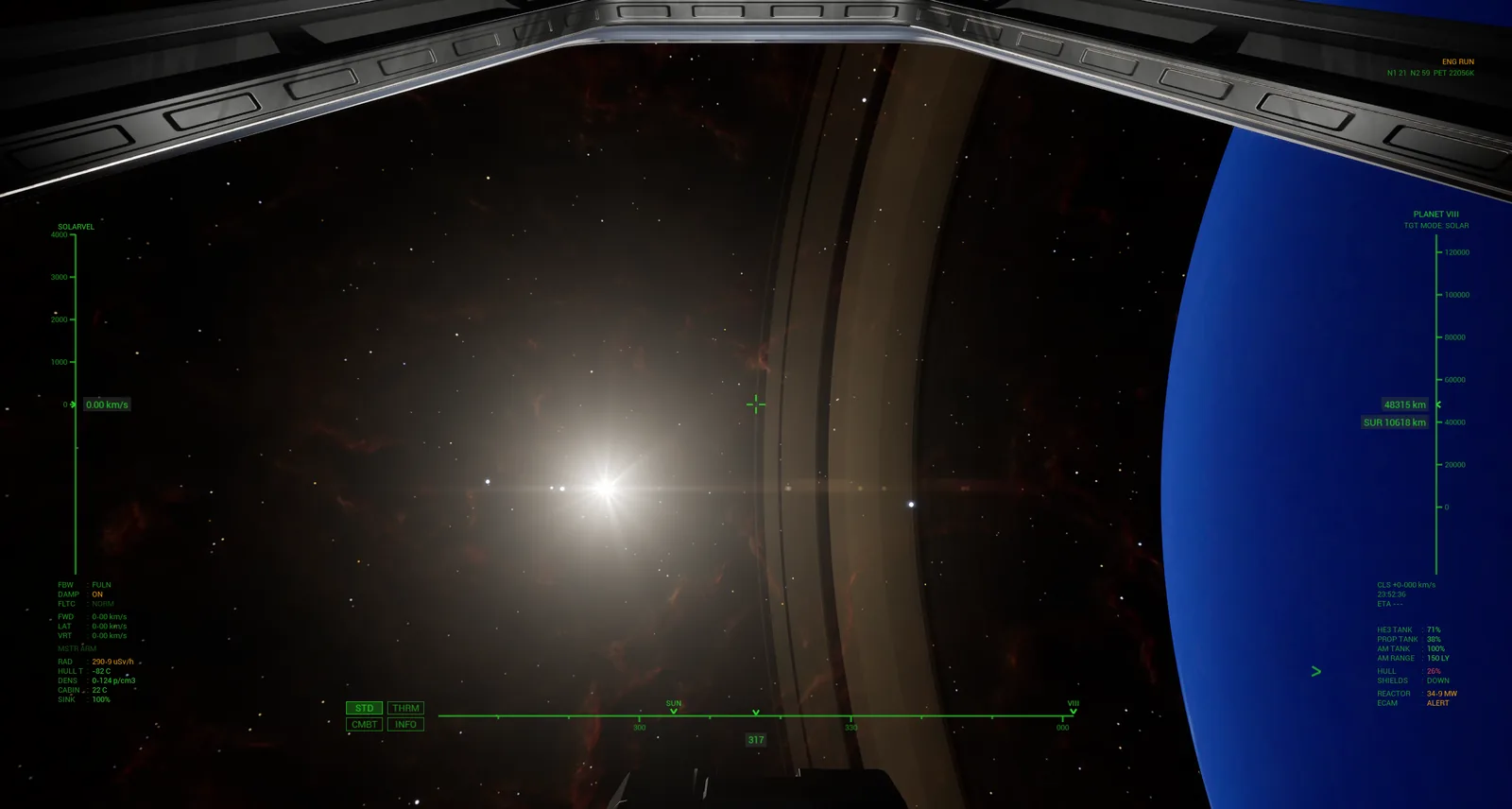
In the gameEvery thrust is force over mass and nothing stops the ship but you. Plug in a Thrustmaster Warthog: two levers for two engines, four flight modes on the switches, and drift dampers that make the pure physics fly where you point it.
In the gameA ship you walk while she flies
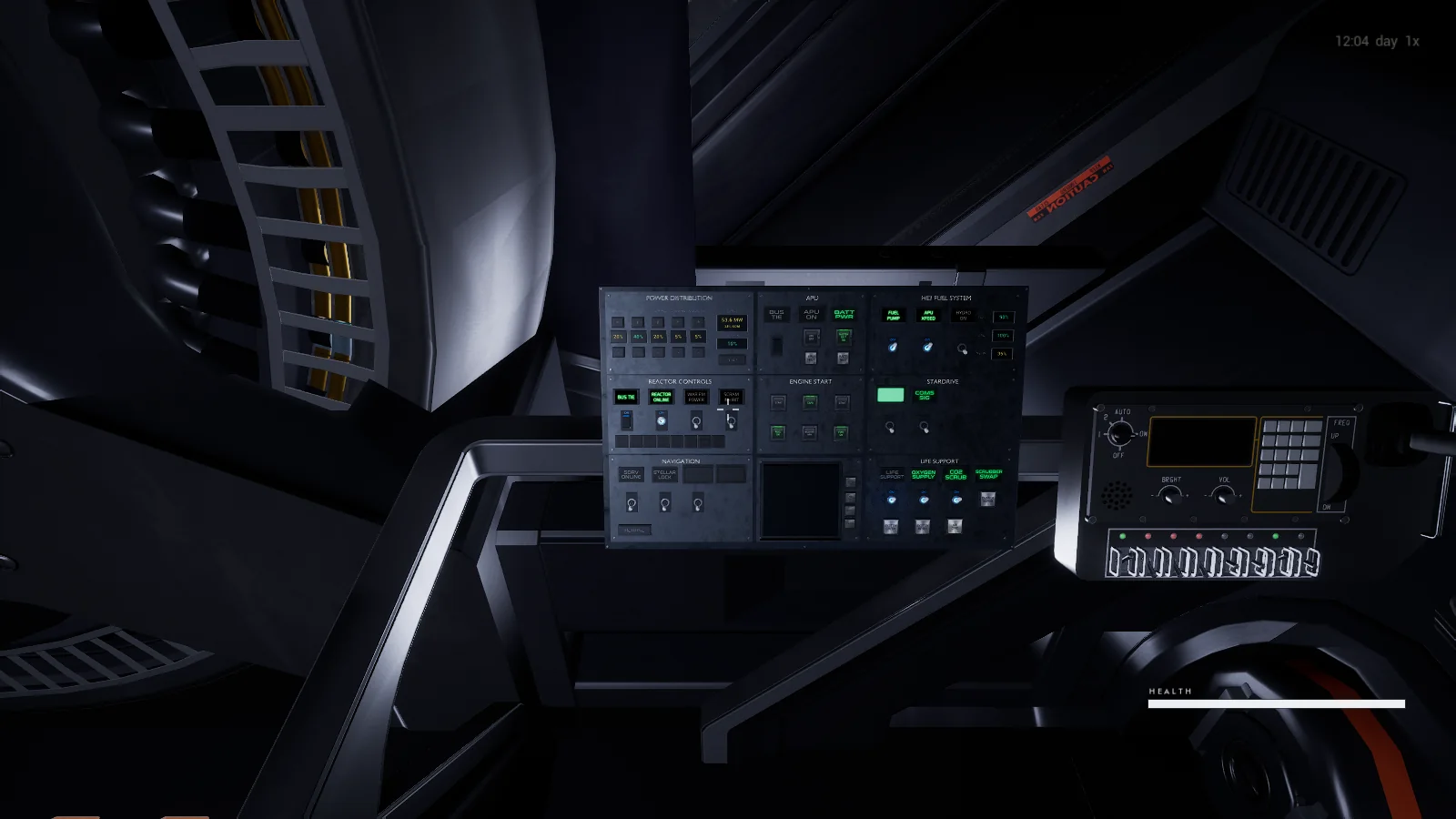
The Calliope: two decks, ten rooms, a crew of seven with names and faces, and live systems from reactor to life support. Stand up mid-cruise and walk aft while the planets slide past the canopy.
In the gameWorlds you land on
Eight whole procedural planets and moons, generated while you play and walkable from the landing site to the horizon: a brine world, an ocean with a ship of the line at anchor, a Mars-sized desert, an airless moon built to the Moon's own numbers.
In the gameGas giants with weather of their own
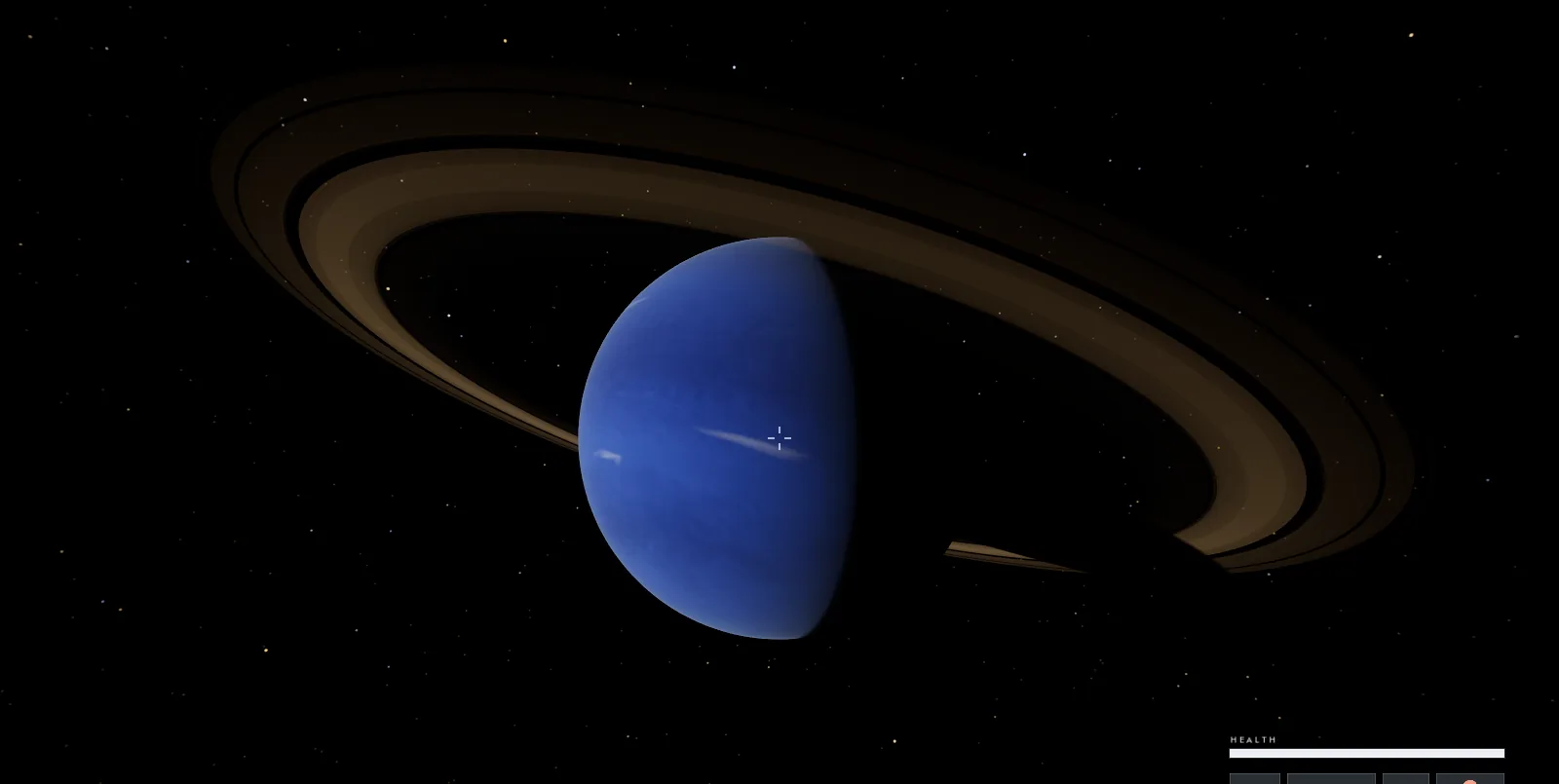
All 1,965 giants in the galaxy carry procedural weather grown from their own seed: cloud bands stirred through a wind field built for each planet, storms, polar cyclones, rings from Cassini's optical depths. Fly down and skim the cloud tops.
In the gameBlack holes drawn by their physics, in a real sky
The Kerr metric solved in closed form, per pixel, bending the real star field behind Cygnus X-1. Twelve flyable stops, from Gaia BH1 to the Crab Pulsar, and every one of the 4,881 known compact objects on the galaxy map.
In the gameThe ground war at Vennik Flat
Hold a fortified company town against droid assaults with six tanks at the wire and a gatling in your hands, then read the After-action Report. Nineteen hero levels, from neon cities to ancient ruins, wait beyond it.

Fly her on a Warthog. Then get up and walk aft.
Two levers drive two engines, each with its own start, fuel and failure. Her reactor, power bus, helium-3 and life support are live systems you read off the overhead panel, built after the Boeing 737's. Her water is her propellant and her radiation shield: a 20 tonne jacket, and the dose model behind the cabin readout agrees with flown dosimeters, from the ISS to Curiosity, within a factor of two.
The crew are on board: Arien Sarhavi at navigation, Cassie, Kade, Corso, Ellis, Odile, and Talos, a bronze robot deck hand, keeping a watch bill and eating at the table. In space the ship is the anchor, so you can stand up mid-cruise and walk aft while the sky keeps moving. Over Luna, other ships land beside her.
- Decks
- 2
- ten rooms, walkable in flight
- Crew
- 7
- named, with faces
- Engines
- 2
- left and right, on two levers
- Sky fleet
- 82hulls
- flying real physics
We began with the stars that have the best data
119,626 stars from the HYG database, corrected against Gaia DR3, Hipparcos, XHIP and the Washington Double Star Catalog, sit where astronomers measured them, each with a generated system. The rest of the Milky Way, 111 billion stars from a published model of our galaxy, is generated by the same simulation and arrives next.
In-game captureGalaxy map, G119,624 stars drawnBuild 0.1.0The sky today
- Stars
- 119,624Catalogue
- Named
- 6,631Catalogue
- Known pulsars
- 4,393Catalogue
- Known black holes
- 113Catalogue
- Star clusters
- 7,304Catalogue
- Generated systems
- 5,160Sim
- Stations placed
- 2,457Sim
Next: the whole Milky Way on the map, 111 billion stars from a published model, generated around the real ones. In development
The physics under the sim
Every system starts as published astronomy, with the paper named. It is where Pax Abyssi is strongest.
- Catalogue stars
- 119,626
- HYG, corrected against Gaia DR3, Hipparcos, XHIP and WDSCatalogue
- Generated systems
- 5,160
- 8,751 planets and 7,495 moons, solved for 2538-01-01Sim
- Known compact objects
- 4,881
- 4,393 ATNF pulsars, 113 black holes, 375 more neutron starsCatalogue
- Kerr ray against the oracle
- 0.013px
- 99th percentile at 1920 wide, Gralla and Lupsasca 2020Sim
- Kepler solve against the original
- 0.8mm
- across nine bodies, per-tick propagationSim
- Radiation dose model
- 2x
- within a factor of two of measured, from the ISS to CuriositySim
The science, shown working
Black holesFour black holes, and why most of them are dark
From Cygnus X-1, fed by the wind of a blue supergiant, to the starved giant at the centre of the Milky Way: what you would see depends on what it eats.
PlanetsThe colours of the giants
Five cloud decks predicted in 2000, tested rung by rung since, and the same physics drawing every giant in the game.
The galaxyWhere the catalogue ends
119,626 measured stars, a Milky Way model of a hundred billion more, and why the two have to add up.
A wiki of the real sky, a forum, and a weekly devlog
The wiki and the forum open with the first public build. Wiki text is CC BY-SA 4.0, every page carries a science status and cites its sources, and the devlog comes out every week with pictures.
Codex
Stars, planets, black holes and neutron stars as science pages with provenance on every value; the setting as lore pages, marked as fiction.
Communities
- Announcements
- General
- Science and astrophysics
- Screenshots and media
- Ideas and feedback
- Bug reports
- Wiki talk
The development
The weekly devlog and build news, straight from the studio. One account for the wiki, the forum and the API.